

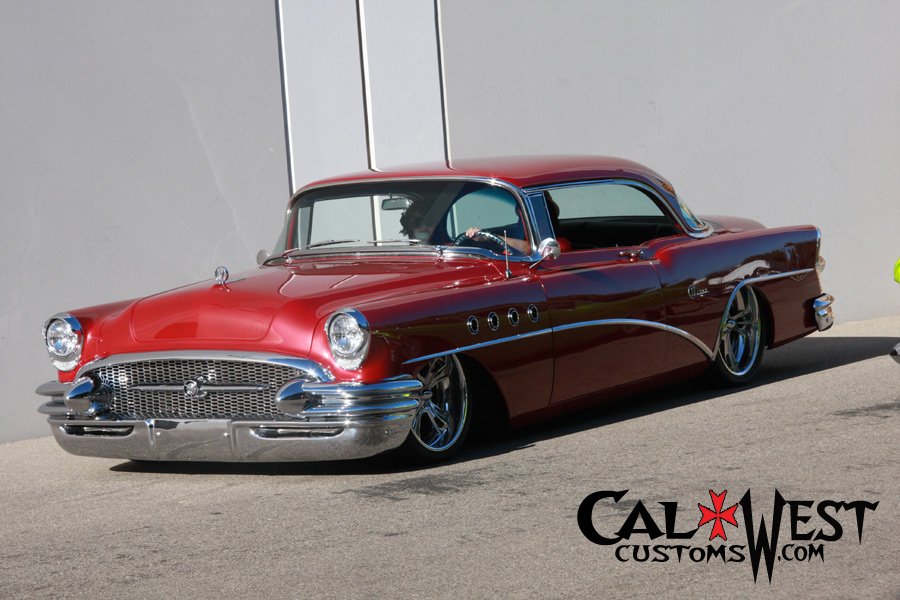
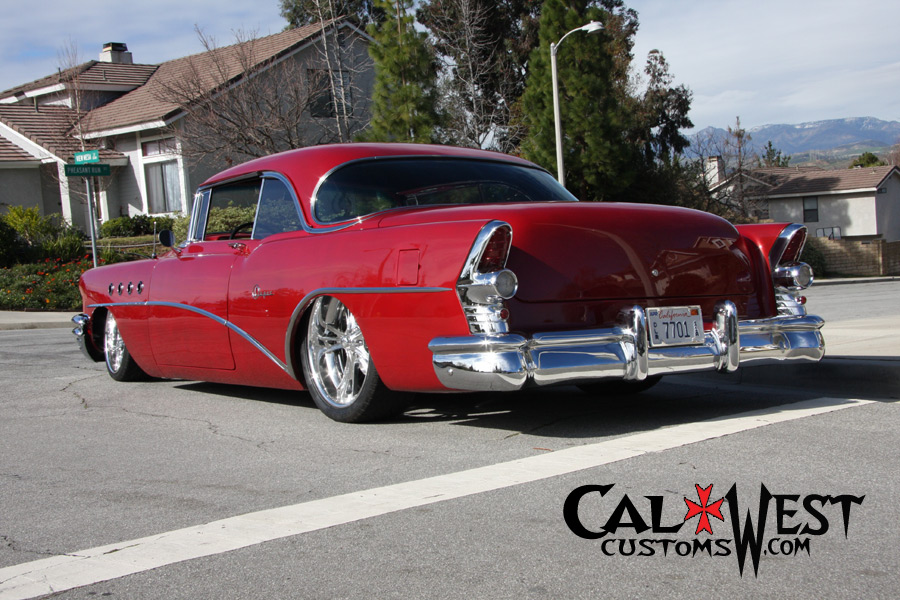
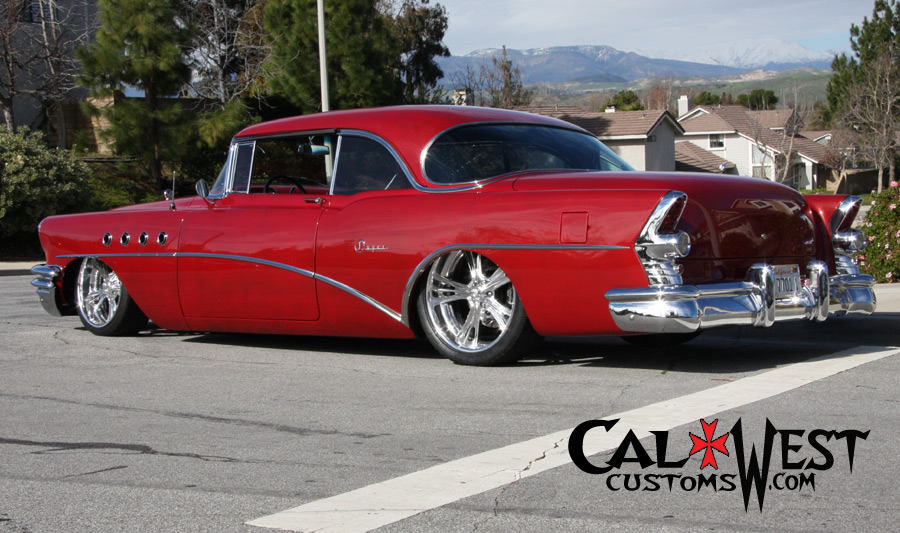
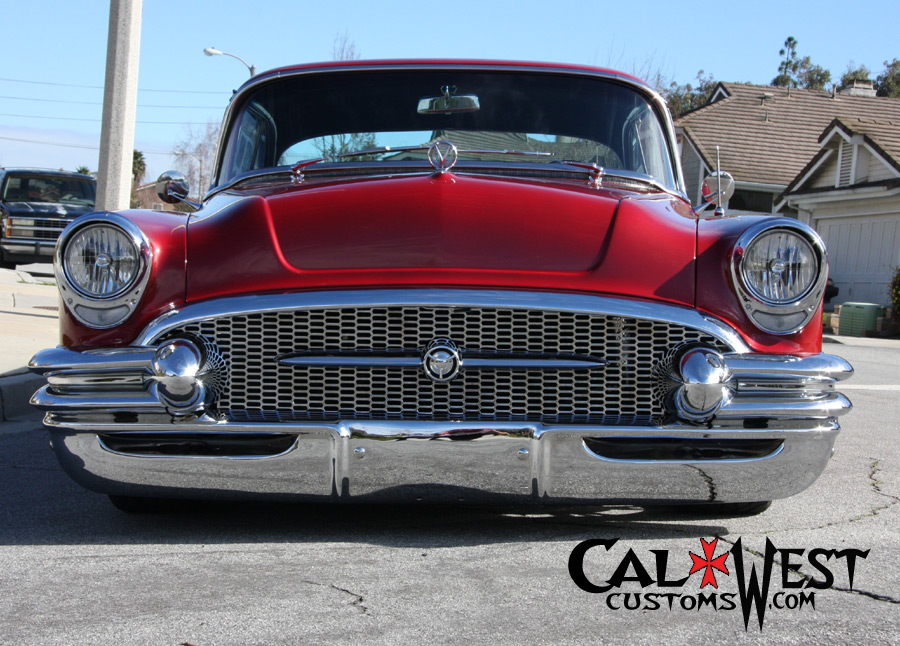
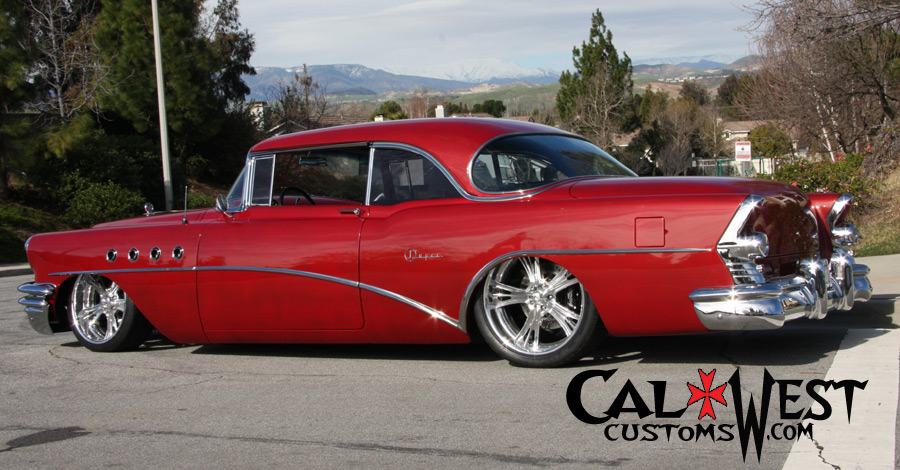
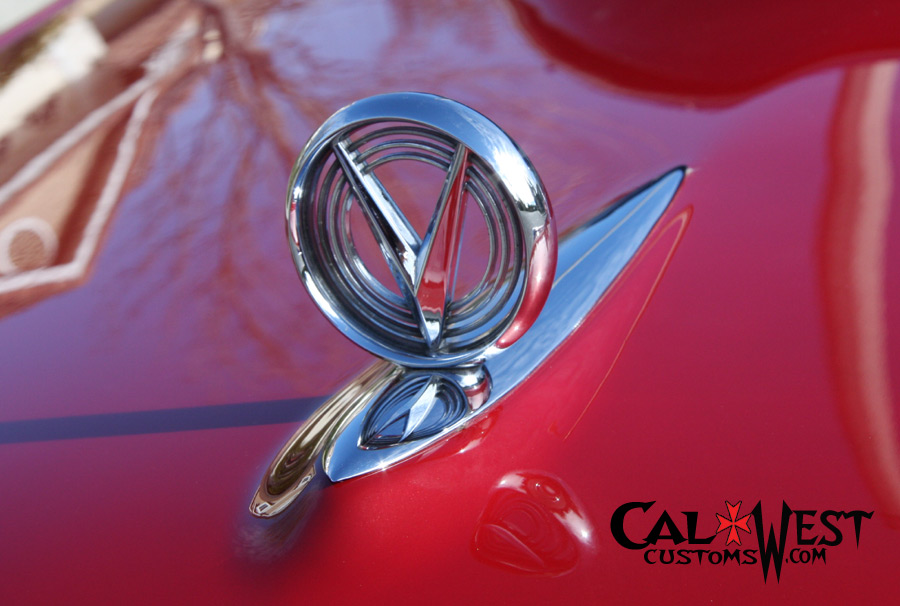
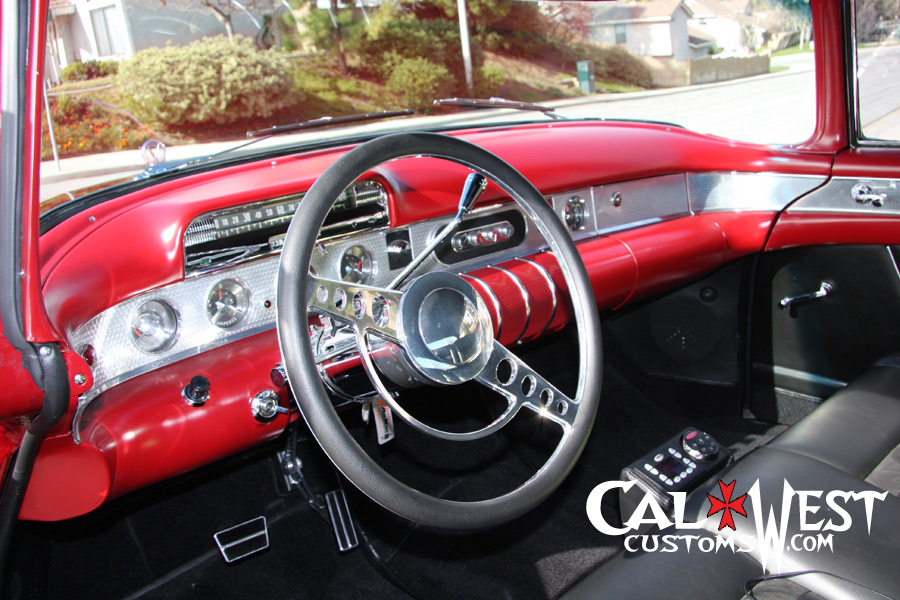
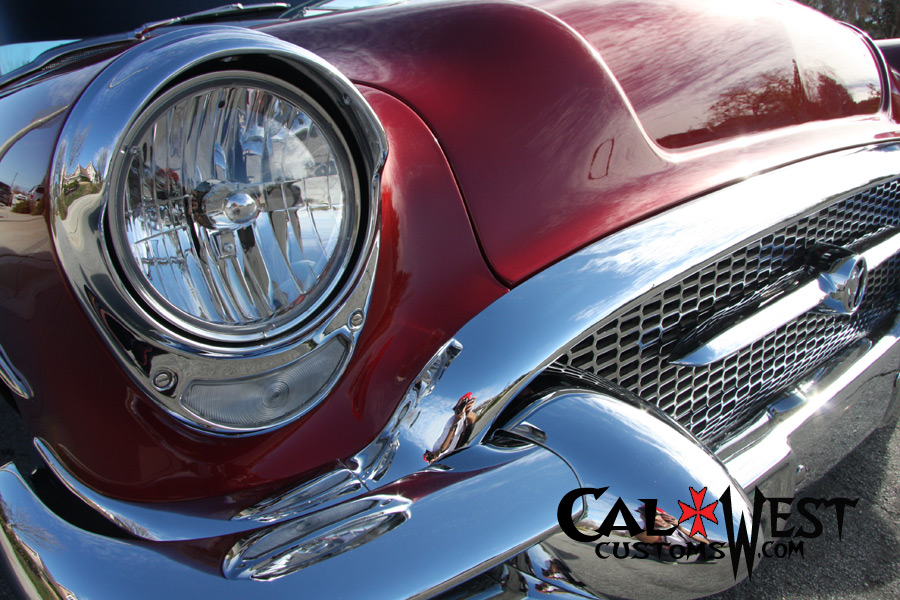
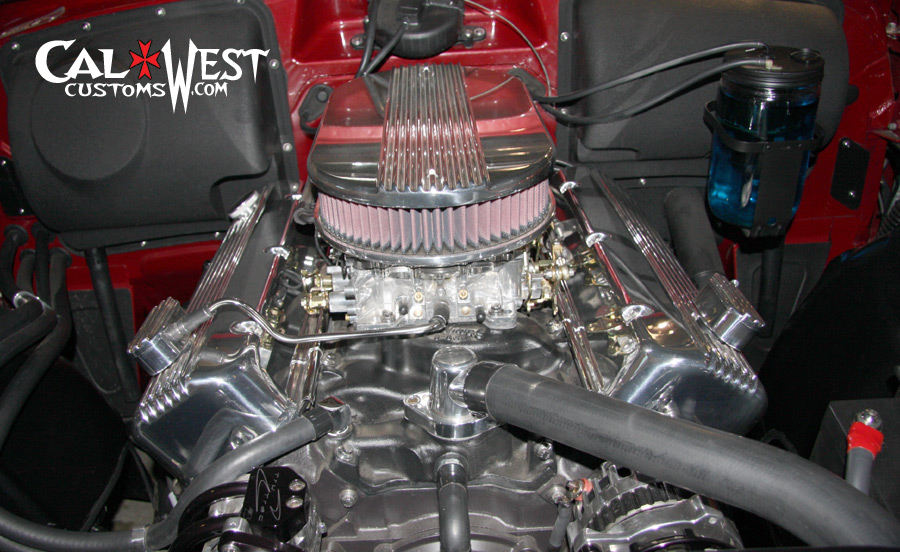
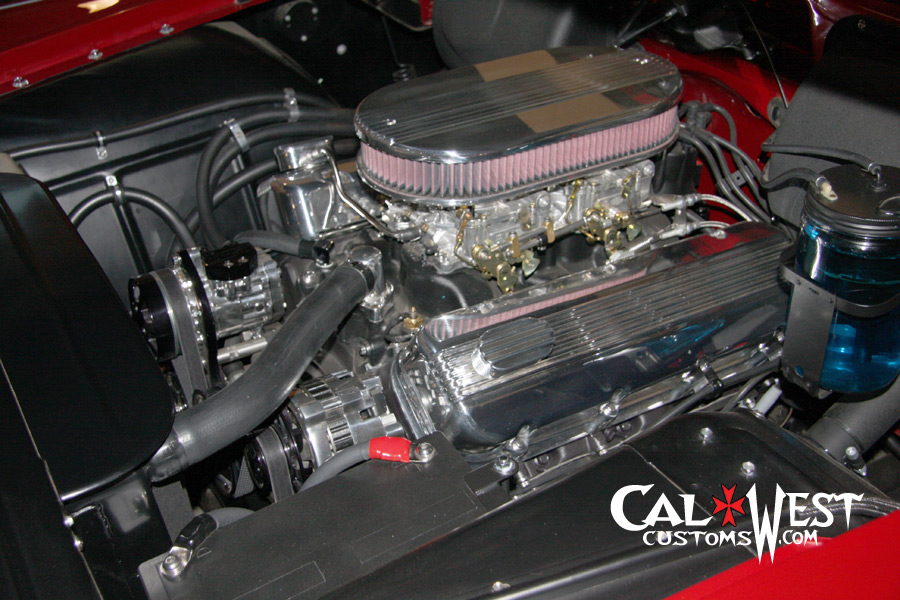
The car known as “R55”. Although it looks like a relatively stock Buick from the shell, it is far from that. The Buick has had a complete frame off restoration, including a completely different drive train, suspension, brakes, and front end clip. The car is equipped with a Chevy ZZ4 502 cubic inch motor, dressed up to look trick, yet old school Buick. The dual carbs feed the motor, and the motor is outfitted with a Billet Specialties True-Trac system, partly powder coated black and partly polished, as well as Billet Specialties new one piece polished billett aluminum valve covers (there said to be cut out of one solid piece of aluminum), as well as a matching air cleaner. Custom long tube headers (Heat coated black) and mandrel bent exhaust let the engine breath nicely. In the engine bay you will notice many of the stock touches were left, like all of the original unique fender bolts, the blue windshield wiper canister, and many small touches that keep the original feel of the Buick. A custom aluminum radiator was fit in for cooling with temperature controlled electric fans. To put the power to the wheels is a built 700R4 overdrive tranny, through an aluminum driveshaft, and lastly into a Currie built Ford 9 inch rear end. Rear suspension is a 4 bar link system with Air Ride air bags and aluminum adjustable shocks. The car is sitting on huge 22 inch Billlet Specialties in the rear, and 20 inch wheels in the front. The 14 inch rotor and 6 piston Wilwood brake setup bring the classic to a screaching halt.The Buick was shot with a deep bergundy color, with lots of added pearl that stand out loudly in the sun. All of the original trim was straightened, undinged and repolished back to original. The 4 vent holes that make it a Buick are all present. The interior shows a mix of both classic and custom. The dash was mostly left all original except for the Vintage Air controls where the original stereo was. The dash was painted in the same color as the exterior, however, in a matte finish. The seats and door panels were done in black leather, two tones with black suede. The headliner beautiful black suede as well. You will notice the “R55” emblems hand made and placed on all the seat backs. Controls for the stereo and the Air Ride suspension are located in a panel hanging off the front seat. There is a 10 speaker system, including all JL speakers and amps. The painted Ididit tilt column with column shift and the Billett Specialties wheel steer the big Buick down the road.Here’s some interesting history on Buicks. The Buick emblem consists of three shields, each bisected diagonally to the right by a straight line, the shields arranged touching each other in a left-diagonal pattern, inside a circle. If represented in color, the leftmost shield is red, the middle white, and the rightmost blue, although white is sometimes represented by light gray. This design, known as the Trishield, was adopted in 1959 for the 1960 models and represents the three models that comprised the lineup that year—LeSabre, Invicta, and Electra. The shields are adopted from the shield of the Buick family crest, which in modified form had been used on Buicks since the 1930s. A version of the traditional crest appeared on Electras through the 1980s.A traditional Buick styling cue dating to 1949 is a series of three or four portholes or vents on the front fender behind the front wheels. The source of this design feature was a custom car (one not made by Buick, but personal car of stylist Ned Nickles), which in addition had a flashing light within each hole, each synchronized with a specific spark plug simulating the flames from the exhaust stack of a fighter airplane. Combined with the bombsight mascot (introduced in the 1940s), the ventiports put the driver at the controls of an imaginary fighter airplane. The flashing light feature was not used by Buick in production, but the portholes remained as nonfunctional ornamentation.These were originally called “Ventiports” as they did allow air flow into the engine bay (later just “portholes”). Ventiports have appeared sporadically on several models since. Lower cost models were equipped with three portholes, while higher cost models came with four. Often, people would denote their cars as “Four-Holers” or “Three-Holers” to assert the car’s class. When the number of portholes was standardized across the entire model line, buyers of the higher cost models complained bitterly that they felt shortchanged. In 2003 they were re-introduced on the Buick Park Avenue. After the Park Avenue was discontinued, Buick salvaged the portholes to appear on the new Lucerne. In a break with tradition, the Lucerne’s portholes refer directly to engine configuration: V6 models have three on each side, while V8s have four on each side.Another styling cue from the 1940s through the 1970s was the “sweepspear”, a curved line running the length of the car. In the earlier cars, this was a chrome-plated rub strip which, after it passed the front wheel, gently curved down nearly to the rocker panel just before the rear wheel, and then curved around the rear wheel in a quarter of a circle to go straight back to the tail-light. During the two-tone color craze of the 1950s, the sweepspear separated two different color areas. After that, the curved line was usually indicated either by a vinyl rub strip or simply a character line molded into the sheetmetal.




|