

From Wikipedia……….
Foundation and early years

Lancia & C. Fabbrica Automobili was founded on 27 November 1906 in Turin by Fiat racing drivers, Vincenzo Lancia (1881-1937) and his friend, Claudio Fogolin (1872-1945). The first car manufactured by Lancia was the “Tipo 51” or “12 HP” (later called “Alfa”), which remained in production from 1907 to 1908. It had a small four-cylinder engine with a power output of 28 PS (21 kW; 28 hp).
In 1910, Lancia components were exported to the United States where they were assembled and sold as SGVs by the SGV Company. In 1915, Lancia also manufactured its first truck, the Jota, that continued as a dedicated series. In 1937, Vincenzo died of a heart attack. His wife, Adele Miglietti Lancia, and his son, Gianni Lancia, took over control of the company. They persuaded Vittorio Jano to join as an engineer. Jano had already made a name for himself by designing various Alfa Romeo models, including some of its most successful race cars ever such as the 6C, P2 and P3.The former Lancia Borgo San Paolo Plant in Turin, where Lancia automobiles were first produced

Lancia is renowned in the automotive world for introducing cars with numerous innovations. These include the Theta of 1913, which was the first European production car to feature a complete electrical system as standard equipment. Lancia’s first car adopting a monocoque chassis – the Lambda produced from 1922 to 1931 – featured ‘Sliding Pillar‘ independent front suspension that incorporated the spring and hydraulic damper into a single unit (a feature that would be employed in subsequent Lancias, up to the Appia that was replaced in 1963). In 1948, the first 5-speed gearbox was fitted to a production car (Series 3 Ardea). Lancia premiered the first full-production V6 engine, in the 1950 Aurelia,[10] after earlier industry-leading experiments with V8 and V12 engine configurations. It was also the first manufacturer to produce a V4 engine. Other innovations involved the use of independent suspension in production cars (in an era where live axles were common practice for both the front and rear axles of a car), and rear transaxles, which were first fitted to the Aurelia and Flaminia range. This drive for innovation, constant quest for excellence, fixation of quality, complex construction processes and antiquated production machinery meant that all cars essentially had to be hand-made. With little commonality between the various models, the cost of production continued to rise, while flat demand eventually affected Lancia’s viability.
Gianni Lancia, a graduate engineer, was president of Lancia from 1947 to 1955. In 1956, the Pesenti family took over control of Lancia with Carlo Pesenti (1907–1984) in charge of the company.
First series
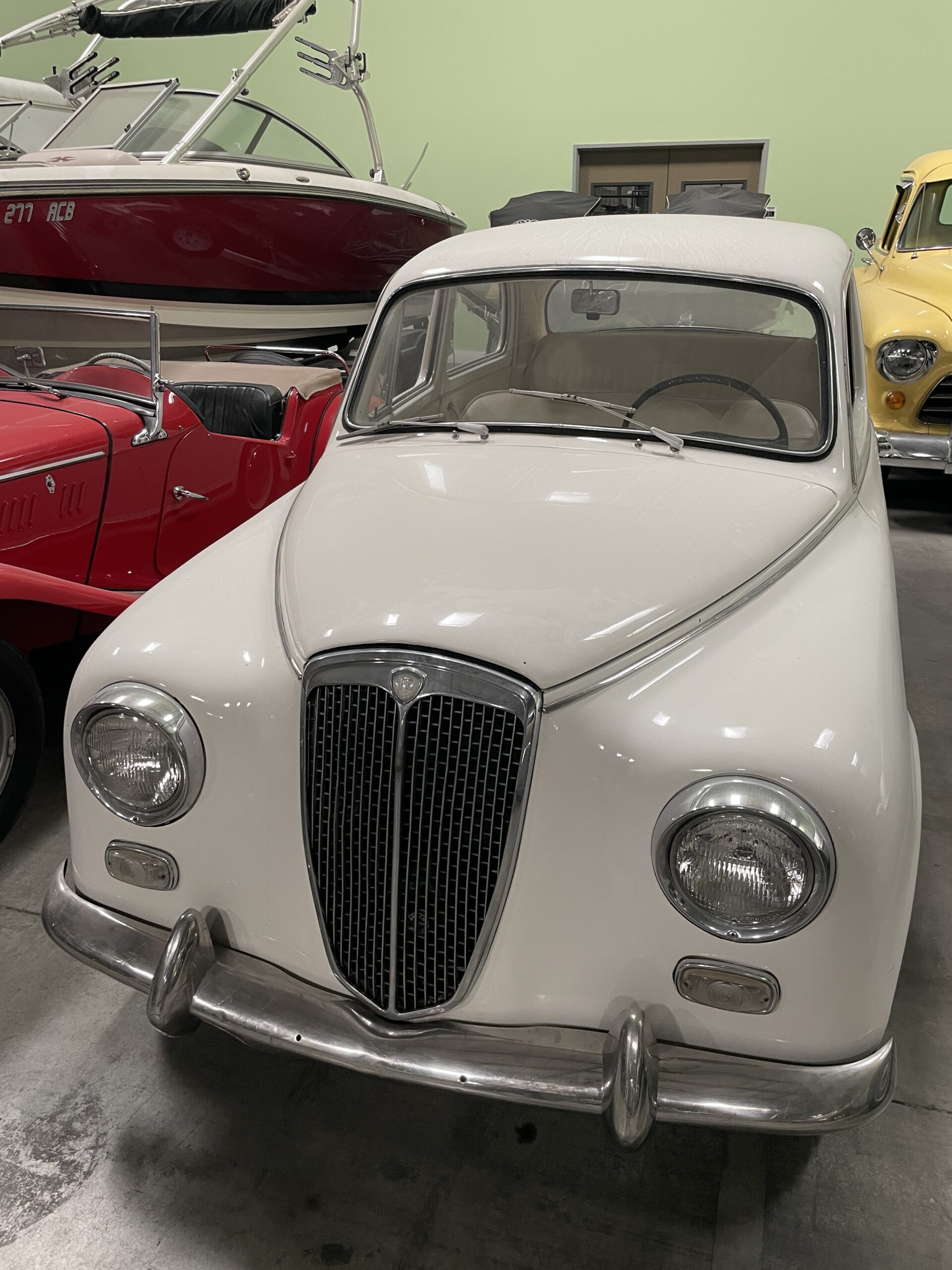
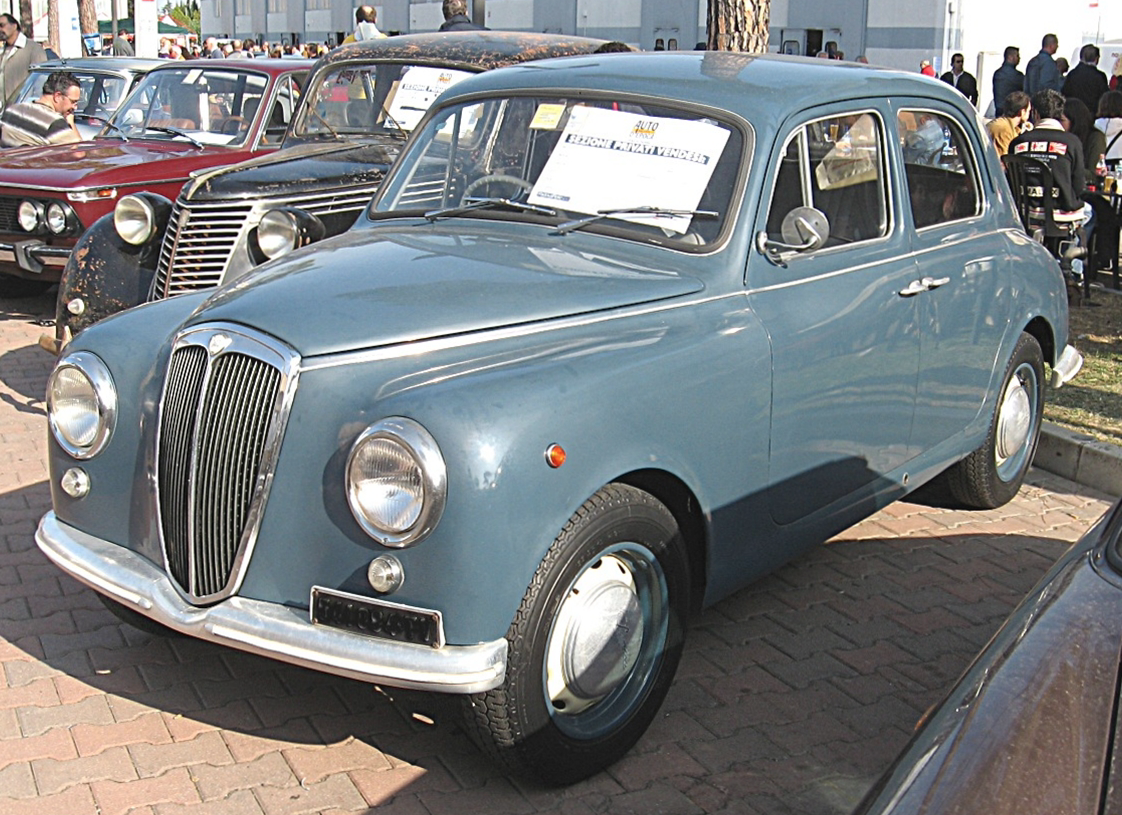
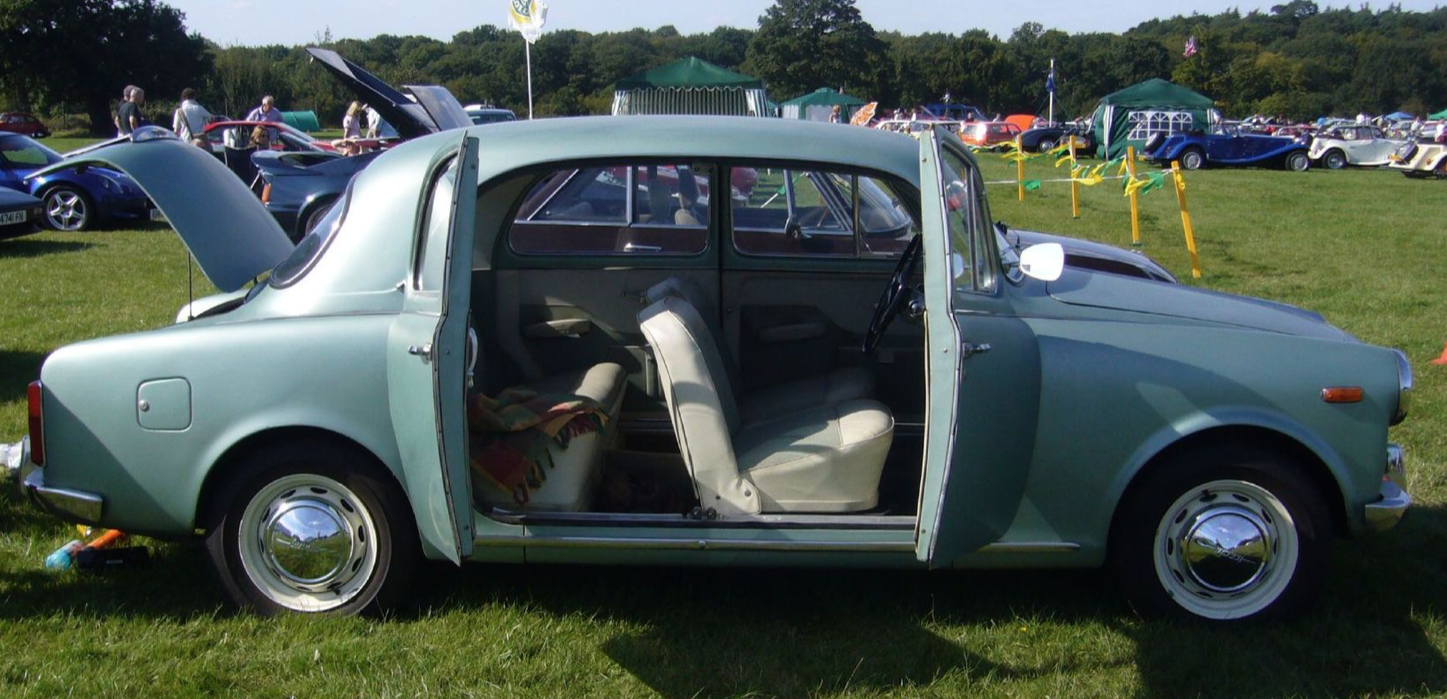
The Appia Berlina (saloon/sedan) was introduced in April 1953 at the Turin Motor Show. The chassis code is C10 for the right hand drive saloon—the standard version, as was customary at Lancia—and C10S (from Sinistra, Italian for “left”) for the left hand drive variant, available on request. Under the Appia’s bonnet there is a 38 PS 1.1-litre engine, which according to the manufacturer could push the car to 120 km/h (75 mph).[3] The body style is similar to the Lancia Aurelia. To save weight, the doors and rear fenders of the first few thousand examples were aluminium. The bumpers were also aluminium, making them easily dented. Rubber stripping was added, to protect them from minor impacts.[3] In a design inaugurated by the 1933 Lancia Augusta, rear doors were aft-hinged suicide doors, eliminating the B-pillar. A spare tyre, the fuel filler and the battery were located in the trunk/boot. The interior featured bucket front seats, a column-mounted shifter, ivory plastic steering wheel and switches, and panno Lancia wool cloth upholstery in grey or beige. Running on 155HR15 Pirelli Cinturato tyres. In total 20,025 first series saloons were made, from 1953 to 1956.[3] Of these, the majority—10,257—were right hand drive, and the remaining 9,768 left hand drive.
The Appia sold in fewer numbers than projected. In 1956, Italian car magazine Quattroruote attributed this to the price, competition from the Fiat 1100/103 and Alfa Romeo Giulietta, and a host of minor flaws, e.g., the aluminium bumpers — indicating a hasty, low-priority development when Lancia was diverting many of its limited resources to its sports car racing efforts.
Second series
In April 1955 engineer Antonio Fessia joined Lancia as technical director, and started off fixing the Appia’s shortcomings. Jano left shortly after, when Lancia withdrew from Formula 1. The resulting second series Appia, introduced at the Geneva Motor Show in March 1956, had a more powerful engine, a modernized body and better interior room. The C10 and C10S type codes were kept. The rear part of the body had been redesigned to enlarge the boot, and the wheelbase was stretched by 3 cm (1.2 in) to provide better rear seat accommodation; this resulted in a 14.5 cm (5.7 in) growth in length. From the front the second series could be recognized from its rectangular instead of round turn signal lamps and the steel bumpers with over-riders. The fuel filler cap was moved outside, under a locking flap on the right hand side rear wing. Fessia’s changes to the engine included lowering the compression ratio, redesigning the cylinder head incorporating hemispherical combustion chambers and a new arrangement of the valves, new pistons, a new carburettor and different camshaft profiles. Output increased to 43 PS, and top speed to 120 km/h (75 mph).[4] In the cabin a front bench seat took place of the two single ones, the binnacle held two round instruments, and steering wheel and switchgear went from ivory to black.
Despite—previously critical—Quattroruote having declared the Appia “finally accomplished and convincing” sales did not take off yet. In May 1958 daily production still lingered at 27 cars per day, far short of the 50 anticipated during the car’s development. In total 22,425 second series saloons were made, only 3,180 of them C10 right hand drive cars.
Third series
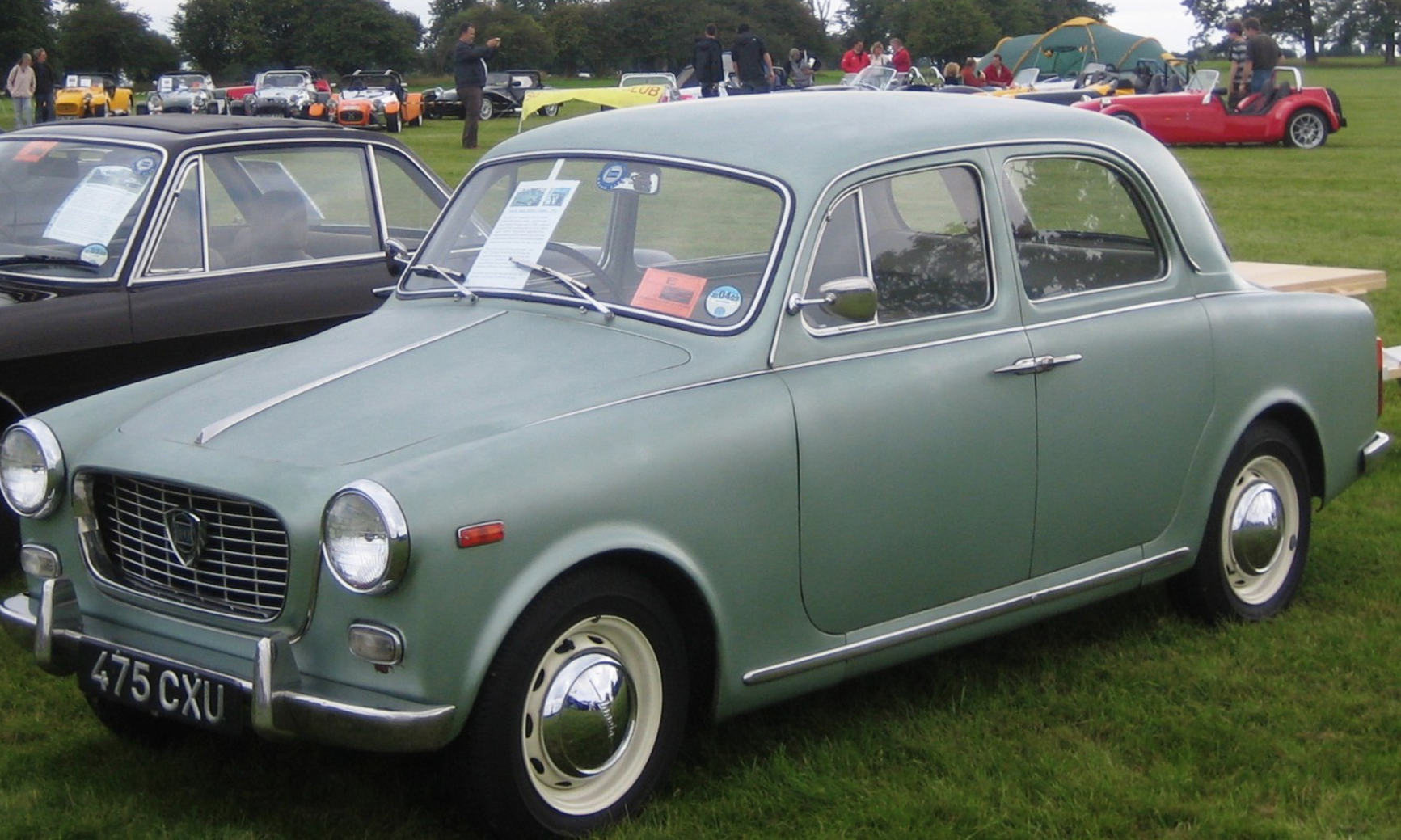
In March 1959, the third series Appia was introduced at the Geneva Motor Show with a new front end. Lancia’s traditional radiator shell-style grille was ultimately abandoned, in favour of an horizontal one inspired by the Lancia Flaminia flagship. Engine power went up again to 48 PS, as did top speed, to 132 km/h (82 mph). The braking system was improved with |twin leading shoe]] front drum brakes and a “Duplex” dual hydraulic circuit during the 1960 model year. Model designations were different from the previous two series: 808.807 for the LHD variant, and 808.808 for the RHD one. In its third iteration the Appia was finally mature, and 55,577 saloons were made, the vast majority in left hand drive.